
Names
Rataskaev (0) 
Wheel well, well with windlass for winding up water, aka draw-well. A development of the older, true windlass well, võllkaev, which saw various additions over time from the wheel to facilitate rotation to realizing the windlass was not actually needed. For whatever reason, Rataskaev is today the best-known well of late medieval Tallinn, although there were a number of others: one about 100 m due N as the rain falls, next to the Pikk Jalg tower, another in the NE quadrant of Raekoja plats, and a dozen or so strung out along the ‘aqueduct’ or channels bringing water from sources just outside the city walls, running from Harju värav, through Kullassepa, across Raekoja plats into Mündi, Pikk and Lai and all the way to Suur Rannavärav. Given that the channels were built in 1420-23, it may have been due to the wells becoming too labor-intensive or no longer capable of satisfying local demand. The earliest records identifying the well include puteus, dictus Sternsod (‘well, named Sternsod’, 1375); sternsode (1379); and the description platea qua itur ad sanctum Nicolaum in opposito putei (‘road that goes to St Nicholas opposite the well’, 1378, see Dunkri). The consensus is that this particular well has been called Sternsot/Sternsod(e) since 1375 at the latest, and has been accused of various origins. The name breaks down into 2 parts: stern and sod, so let’s start with the first. Modern German Stern means ‘star’, but here it seems to have a different meaning (the use of ‘star’ for multi-street junction does not seem to be very old): from MLG stēn or stêrn(e), i.e. stone and, by extension, calcareous or lime causing the water we now call ‘hard’. So 2 options there, to which we return later. The 2nd part is more complex and seems to bring various etymological strands together. The first one comes from the number of towns in Germany ‘Soden’ in their name, 4 in Hesse and 2 in southern Germany, all known for originating as settlements near a mineral-rich spring. The Hesse dialect sets the stage with Sod or Soden conveying a sense of uprising and welling as in ‘boiling’, ‘churning’ or ‘surging’, but also meaning Ziehbrunnen, or draw-well. Looking at other MLG examples, we have: 1) sōde or soede: a slab of peat or turf; 2) sōde or sodde, ‘boiling’, ‘broth’, ‘spring’ or ‘well’; 3) sōde, a ‘narrow passage between houses’; and 4) sōde, ‘heartburn’. Given the well’s location, No.3 can be dismissed. No.4 is interesting in its sense of warm, surging reflux, but it’s a later (16th-C?) derivative. No.1, with definitions swirling around peat bogs, heating-fuel, and general mushiness, perhaps serves more as a reminder of how words can creep and crystallize into newer or reinvented meanings, or simply mislead due to serendipitous similarity, another way of saying we don’t really know. For some, it may come from 9th-C OHG sou, related to words involving dripping or sucking. As to No.2, the question is: which came first? While the answer may not be known, it is likely that the word designating the founding economical feature, the spring, became enshrined in a more palpable object, the well, in a similar manner to, e.g., Vaksali. Lastly, since ‘spa’ water is often carbonated, this revives the ‘stern’ issue, suggesting a possible related original. To conclude, inconclusively, were it true, a brackish, briny or carbonated spring might be notable and nameworthy but, lacking hard evidence, the most probably explanation is simply that: a stone-built well. Discussion TBC on the website. For information, located at ///unless.friday.greeting. the current well is a replica. For the street itself, see Rataskaevu.
Rataskaevu (Rataskaev)
See previous entry for the meaning of the well itself. As to the street name, we need to go back a bit... This is going to be a bit long, so settle down with a drink in a comfortable armchair, cancel the milk and say goodbye to anybody over 50... The street was first recorded in 1328 as platea dicta dummestrate (street known as dummestrate), then sub monte (1348) and sub monte sitam penes machina (below the hill near the machine / apparatus, 1381), and sternestrate (sterne street, 1489-1521), after the well (see Rataskaev), putting it into 3 neat, separate phases: 1. street name; 2. temporary feature; 3. permanent feature. The first word to look at is dummestrate. We can ignore the different spellings – dume for Aleksander Kivi, and dumme for Zobel, KNAB and others – 1 ‘m’ or 2 is a minor issue. But what does it mean? For Kivi (and most people since then), it translates to hoob, generally understood as a cudgel or a wooden beam or stave used for levering or prying (cf. German Hebel), but Kivi goes on to suggest it describes a machine or device for lowering blocks or slabs quarried from the Toompea limestone bank for local construction. In principle, this seems eminently sensible since this activity would likely have continued for centuries. But hoob doesn’t seem to map onto machina. One’s a stick, the other’s an apparatus. MLG dumme/dume seems to derive from the PIE root *dheu‑ or *dʰueh₂ which gives us modern English words such as dizzy, dust, death, deer and donkey, a rather motley bunch, but let’s look at how it spread among various IE languages. It may look complicated, but actually it’s not. Just relax and enjoy the bizarre scripts and spellings for what they are, attempts to pin down ‘now’ for all time. We start with the oldest languages and move up:
- Hittite: duḫḫuiš, smoke
- Ugaritic: dġṯ, smoke, incense
- Sanskrit: धूलि (dhUli) dust, and धूम (dhUma-) smoke, fume, but also mist, wheat and... saint!
- Ancient Greek: θῡμός (thūmós), soul, breath, rage and life; or θῡμος (unaccentuated o), thymus or warty excrescences found on the genitals, anus or other parts of the body, but also modern Greek, θύμος, thyme, and other strong-smelling plants
- Latin: fumus: smoke, steam or sign, and its cognate fimus, manure and later Latin, shit, leading to French fumier (manure) and fiente (guano, PC for birdshit) and so on
- Old Church Slavonic: дꙑмъ (dymŭ), smoke
- Gothic: 𐌳𐌰𐌿𐌽𐍃 (dauns) smell, odor
- Old Norse: daunn, stink
- MHG: dunst or tunst, steam, mist or smell, as well as doum, bung or blockage
- MLG: either düst / dust for dust, chaff, pod, hull, etc., or dūne for down.
- Low Dutch: donst, dust, down (chick feathers)
- Lithuanian: dulkės, dust; dustininkas, alcoholic with bad breath, poss. due to their adding dùstas, insecticide (but this could be anecdotal)
- Polish: dymy, smoke (cf. Dymy nad Birkenau [Smoke over Birkenau] by Seweryna Szmaglewska)
- Bengali: ধোঁয়া (dʰõa), smoke
- Armenian ծուխ (dzukh), smoke
I think we can agree there’s no clear-cut solution but plenty of mixed signals, e.g. English ‘death’ vs Greek ‘life’, remembering that English ‘black’ is cognate with French blanc (white cf., blank), and this is what language is all about: it’s subtle, slippery and mercurial. But there are principles. And words did not not exist just because there’s no record of them, which is why linguists use the * symbol to propose words and meanings either probable or deduced. Here, the overall sense is twofold: 1) something ethereal, both outside and in, hence death, breath, dizzy, fragrance and soul; and 2) something collective, physical, light and dispersed, hence mist, smoke, dust and down. As to donkeys, this may simply be a by-product of the color dun, close to those associated with smoke, dingy, ash-grey or browny-yellow. So, bringing these various threads together, I propose the following: *dūme, a dusty haze or a foul smell. Is there any corroborating evidence? If we can assume that the street did indeed have a limestone bank quarried for building material, as it was known to have had, then dust would be inevitable. And what is the characteristic feature of a limestone quarry? The smell. Of what? Basically: farts, hydrogen sulfide, H2S. A number of limestones smell of rotten eggs when struck together, some may contain pyrite (FeS2), adding grit if not glitter to the flatulent mill. In the Mendip Hills of Somerset, Britain, for example, there is a carboniferous limestone that locals call ‘stink stone’ due to the smell it produces on quarrying. And so on. And if that ain’t quod erat bloody demonstrandum, I don’t know what is (it’s not). Moving on the the next one, if (and we may or may not) we can dismiss the idea of a machine or device for quarrying, what do we replace it by? Salminen suggests that machina refers to the mint’s coin-stamping die, which sorta sounds feasible (see Dunkri), but I’m not convinced that something almost necessarily kept out of sight would be used as an identifying feature. Was it a metonym for the mint building itself? Maybe, but perhaps there is another interpretation, also involving – PARENTAL ADVISORY – the removal of rocks... Firstly, a well in a city blessed with water does not seem a noteworthy landmark in itself, although on a hill it may admittedly be useful, but in a city as certifiably soggy as Tallinn I’m not so sure, all the more so since there were half a dozen in the area (although more to the NW). Secondly, other than salient features, medieval street names often reflected their main activity or occupants – Kinga, Kullassepa, Munga, etc. In some countries, street names where prostitutes plied their trade were often crude and clear, such as Paris’s rue Brise-Miche (Bum-buster Boulevard) or rue du Poil-au-con (Twat-Thatch Road, now rue du Pélican, Pelican rd). England had its Gropecunt Lanes and Lift-the-Skirt Alleys. When they disappeared, bowdlerized to Grope and Grape, for example, it was along with the Protestant reformation or the spread of syphilis (about which Catholics were unsure which was worse) which, in Tallinn 1586, caused prostitution to be banned and the lõbunaised (pleasure-women) driven out of town. Prior to this, they seem to have been tolerated, to the extent of being allowed to pay taxes. Thirdly... gets a bit complicated here: dume may well mean what Kivi suggests but, as they say in French, un train peut en cacher un autre, there may be more to this than meets the eye. In MLG, dume, duum, or duym meant ‘thumb’, as in MHG, dûme, Old Friesian, thûma, Old English þūma, Middle English thombe, etc., DTV’s Etymologisches Wörterbuch des Deutschen tracing its etymology back to “der Geschwollene, Dicke, Starke” (that which is swollen, thick and strong), cf. PIE *tum- ‘swell’, Eng. tumulus, tump (from Welsh twm, tymp, tympath: mound of earth), etc., Lithuanian tumėti, ‘to thicken, clot’) and the thumb has long been a symbol for the penis: the ‘phallic hand’, for example, a gesture dating at least back to Roman times, the erroneously-named ‘fig gesture’ or mano fica, etc., in modern Italian: a clenched hand with the thumb protruding between the fingers symbolizing the coupling of male and female organs, where fica is slang for the vulva, not ‘fig’ which is fico. Next, again Kivi may well be right in his interpreting of sub monte penes machina but a) penes in this situation means ‘at, by or near’ and, governing the accusative, should be followed by machinam (sing.) or machinas (plur.) not machina; b) penes is also the Latin plural of ‘penis’ (derived from ‘tail’) and, c) although machina was a device or a crane, etc., it was also the place above a stage where the gods appeared and spoke (whence the expression deus ex machina) or a platform for displaying slaves for sale, and the Latin prostituere, prior to its current and more immediate meaning of to actually prostitute, meant ‘to expose publicly for prostitution’, deriving from prostāre, to stand before, to expose oneself to view. Grammatically, it might not match (although Latin had been going downhill for at least a 1000 years by this time), but a pun or euphemism may well have been intended: in medieval English and French, a brothel could be known as a convent and a madam an abbess. Further, prostitutes in medieval Europe often congregated around wells, which opens up yet another bag of snakes: modern-day French pute or Italian puttana (whore) seem likely to come from Latin putidus stinking, which also reflects man’s love-shame-loathing relationship with sex (one 16th‑C English slang term for prostitute was fling-stink), puter:putris means corrupt, wanton, lascivious (the expression in Venerem putris means giving oneself up to the deliquescent pleasures of Venus...), and a well is puteus (an orifice available to all... What better metaphor for a prostitute), all of which are close enough for confusion and conflation to occur. Lastly, the well is very roughly equidistant (±250 m) between Neitsi torn and the historic bath-houses (with which prostitutes have been associated since Roman times) either side of present-day Nunne. As to whether the latter sisters actually rented rooms to them I shall not even discuss, but see Müürivahe. So, putatively, if you will forgive the unfortunate pun, we conclude that Rataskaevu might have been one of Tallinn’s medieval red-light districts. Or might not. The evidence is not conclusive. As an aside, in the very early 1930s, a certain Anna Maria Anspuu, nicknamed Dunkri Lonni, plied her trade as prostitute in a house on the corner of Dunkri and Rataskaevu, described by one journalist as pealinna kõige hirmsama koha (the most fearsome place in the capital), before being murdered on 1932-02-25. To wrap up on a calmer note, in the 1920s, along with standard hotel names such as Kuld Lõwi (golden lion), Commerz, Tsentral, etc., Tallinn seemed quite francophile, with hotels such as Franzia, Belgia and, in this street, to the delight of B&W film buffs, a Hôtel du Nord. All beaten by St Petersburg Hotel, claiming existence since the 14th C. During the Soviet period, street renamed (1950-1987) as Rüütli.
Rätsepa (Rätsep)
Tailor, from rätt (and Sepa), today used more in the sense of kerchief (cloth being riie [giving riided, clothes], lapp [used more in cleaning contexts], or kangas [fabrics, material]), but might have had a broader meaning in the past. Earliest street-name records give Johann Retsepp (1725) but, given the variability in 18th-C name spelling and change (e.g. Johannes or Jaan and Rätsep(p) or Schneider), he remains untraced. One of an occupational street-name group. See Jahimehe.
Ratta (Ratas)
Wheel. Parallel to Rulli. Probably loaned from Lithuanian ratas (before the arrival of Ger. Rad), and fairly widespread across FU languages, this is quite an ancient loan. The plural, in Est. as well as Latv., Lith., Finn. and other FU languages is often wagon or cart. In Est. as in Eng., the same pl. may also mean car. Russian ‘wheel’, колесо́ (kolesó), on the other hand, is related to Eng. cycle, and Anc. Gk κύκλος (circle), whose pl. κύκλοι or κύκλα, also became ‘wheels’… These, along with Eng. ‘car’ – via French < Latin < Gaulish karros from PIE root *kers- ‘to run’ – are related to PIE *kʷel-1 or *kʷelǝ-, to turn or revolve, as is (prob.) also French ‘neck’, cou.

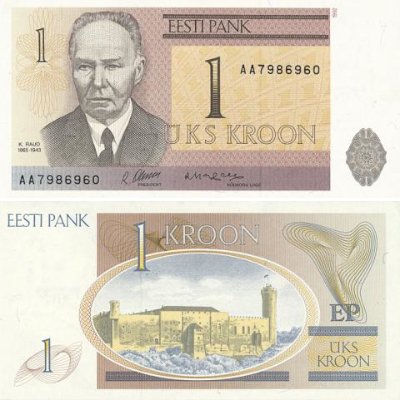
Raua K. (Kristjan Raud, 1865-1943)
Painter and illustrator of folklore characters and bizarre mystical phenomena such as flying lakes (given the country’s average rainfall, perhaps not that mythological at all). Best known for his depictions of the Kalevipoeg, see Kalevipoja. The 1935 edition being (then) an almost must-have in every Estonian home. His cheery face adorned the 1-kroon note (for information on Estonian currency, see Krooni).