
Names
Ahju (Ahi)
Stove, oven, kiln. For those interested in trivia: one of the two >3‑letter street names whose letters are in alphabetical order (see Hiiu). Started life simply enough in German as Töpfergasse (1882), potter’s street, apparently after a local craftsman called Floss, then Estonia stepped in with only four of its six main possible spelling permutations – Pottisseppa, Pottiseppa, Pottisepa and Potissepa (all 1885) missing out not only the most sensible, Potisepa, but also the most accurate, Pottsepa, and why compound words involving sepp (smith) do not usually involve a genitive in the first place I don’t know (see Kullassepa, Rätsepa & Sepa*) – then the Russians either translating it lazily as Гончарный пер. (Goncharnyy per., pottery lane, пер. i.e. переу́лок, pereúlok, in 1892) or as Печная ул., (Pechnaya: stove, oven, kiln…, 1884). Interestingly, the apparent shift from stove to potter is because an Est. pottsepp was not always a potter but often a stove, oven and heating-system maker or repair guy. Either way, given the humungous alternative of An der alten Wasserleitung (1881) or am Stadt-Wassercanal (1882) from the water supply prolonging that of Veerenni, a four-letter word was probably in order, and an anagram of Jahu it became.
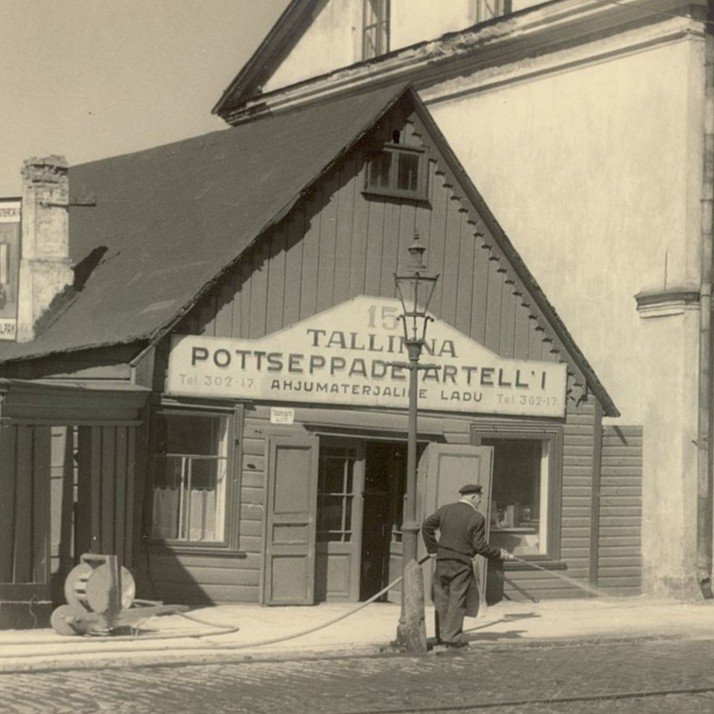
* Although perhaps they do, see Nõmme.
Ahtri (Ahter)
1) Stern, poop; 2) By extension (no pun intended): buttocks, (often) ladies’, (usually) generous. Term borrowed from Low Saxon and Swedish seafarers, and related to ‘aft’ and ‘after’, as well as ‘off’ and ‘ebb’. Known until 1958 as Simeoni, Siimeoni, Siimoni or Simuna after its Saints Simon and Anna orthodox church (built 1752-1871), now known as Püha Siimeoni ja naisprohvet Hanna kirik (Saint Simeon’s and Prophetess Anna’s church (see Paadi). Part of the E67 from Helsinki to Prague, see also Reidi.
Ahvena (Ahven)
Perch, European perch, Perca fluviatilis. At various stages of Tallinn’s past, new or developing neighborhoods were given names revolving around a theme. This one – on the Kakumäe peninsula, site of former fish processing and refrigeration plants – is part of a fish group, see Havi, interspersed among a fishing-tackle group, see Abara.
Aia (Aed)
Fence, enclosure, garden, run. However, as in English where ‘garden’ originally meant that which enclosed it, as in, for example, Latin: hortus gardinus, ‘enclosed garden’, deriving from Proto Indo-European (PIE) *gher- ‘to grasp, to enclose’ (cf. Old English geard ‘enclosure, garden, house’, etc.) ultimately giving rise to Old Church Slavonic gradu*, ‘town, city’ and Russian город (gorod), град (-grad), English girdle and yard, and related to PIE *gherdh- ‘staff, pole’. The same seems to apply in Estonian where the aed originally meant an enclosure made of pickets (cf. Finnish aita, fence). Only Tallinn street name a palindrome in the genitive, but not the nominative. Rare in existing in 3 varieties. For details, see, in reverse alphabetical order: Aia [tänav], Aia [tee] and Aia [käik].
* Given the complications of displaying ‘exotic’ scripts online, here Glagolitic, see, and ideally buy, A Rambling Dictionary of Tallinn Street Names (all author earnings from the book go to the Tallinna Lastehaigla Toetusfond (Tallinn Children’s Hospital Foundation, set up to aid purchase medical equipment), allowing you to contemplate, with wonder I hope, one of humanity's multiple endeavors at reproducing the infinite subtleties of speech in a pathetic 20-odd alphabet.
Äia (Äi)
Father-in-law. Along with äio or äiolane (äi:äio in Võru dialect), it also means ‘devil’ and its attendant adjectival consequences: damn, bloody, fuck(ing)... shedding a grim light on Estonian in-law affinities. By the same logic, äiatar, strictly ‘field scabious’ (see Jaanilille), also translates as female devil, as well as, logically, mother-in-law. Curiously, while ‘mother’ in Estonian and Finnish are respectively ema and emä, ‘mom’, ‘mommy’, etc., in Finnish it’s äiti. See Hõimu. Another street fractionally outside Tallinn, in Iru.