
Home
Nõmme (Nõmm)

Heath, moor, moorland. An odd one: although the nõminative is Nõmm, as far as streets or Districts are concerned, it’s never used. Elsewhere (e.g. Harjuorg, etc.) the occasional District is in the nominative for reasons of geographical descriptiveness, and if the Estonians can gather their wits enough to call a Kesklinn Kesklinn, they should be able to do so here. On the other hand, elsewhere they do the opposite, calling the District Tõnismäe (genitive) and the street Tõnismägi (nominative, with neither tänav nor similar appendage). Perhaps we are entering one of those nebulous areas of linguistics where the object’s appellation has a greater or lesser semantic footprint according to what it designates. Whereas a town center or valley has a relatively identifiable quality about it, a heath is woollier, its perimeter, profile and even ‘heathiness’ morphs according to weather or season. Does its name refer to the land or the vegetation (compare the English cognates ‘heath’ and ‘heather’ and German Heide [heath (Feldmann et al.’s Baltisches historisches Ortslexikon translates nõmme as either Heide or hügeliger Sandboden, hilly/moundy sandy soil)] and Heidekraut [heather, or heath herb], all ultimately derived from proto-Indo-European *kait, open, unplowed country)? Perhaps its lack of definiteness implies more frequent usage in association with other words, in Estonia, the corollary of which is a necessary genitive. In Finnish, with which it seems to share its commonest ancestor, it’s nummi:nummen, where the nominative ends in a vowel and the accusative vice versa. The (An?) Estonian genitive used to end in -n, but this apparently disappeared sometime between the early 13th C and the 16th C, and seems to exist today in very few words, if not one: Maantee, (which also happens to be the name of a village on the southern tip of Saaremaa) but see Sompa. One of Tallinn’s 8 Districts (Linnaosad). It includes the following Asumid (Sub-districts): Hiiu, Kivimäe, Laagri, Liiva, Männiku, Nõmme, Pääsküla, Rahumäe, Raudalu and Vana-Mustamäe. See Pirita.
Nõlva (Nõlv)
Slope, declivity, and the road does drop down to various docks, Hundipea and Paljassaare. Previously known as Polaari (1923-1939) or Полярная (Polyarnaya) (1916-) and next door to Lume, it is tempting to think of ski slopes but while it probably doesn’t refer to them, the docks may have been designed to work on ice-breakers.
Nõgikikka (Nõgikikas)
Black woodpecker, Dryocopus martius (see Rähni). Another bird with more names than feathers. I spare you the details. Breeds in Estonia. Wiedemann gives Kampfhahn, Machetes pugnax which is the ruff (now referred to as Kampfläufer, Philomachus pugnax), with Schwarzspecht (black woodpecker), covering his perse with a question mark. Here, however, amid the assarting street-name area, it is the name of a sooty, fireplace/stove/chimney spirit, one seemingly attributed with positive qualities as seen in various Võro idioms such as one when somebody throws a child’s (hopefully milk) tooth onto or behind the stove, saying Nõgikikas, säh, sulle luuhammas, anna lapsele raudhammas (Hey, Nõgikikas, we're giving you a tooth of bone, give the child a tooth of iron). The name also seems interchangeable with Viruskikas, where virus is the top of a stove, and viruskikas (which can also be a cricket) back-translates from Võro to Estonian as kurukikas, ‘nook/cranny cock’ or, PCly, ‘nook/cranny rooster’.
Nõelasilm (0)
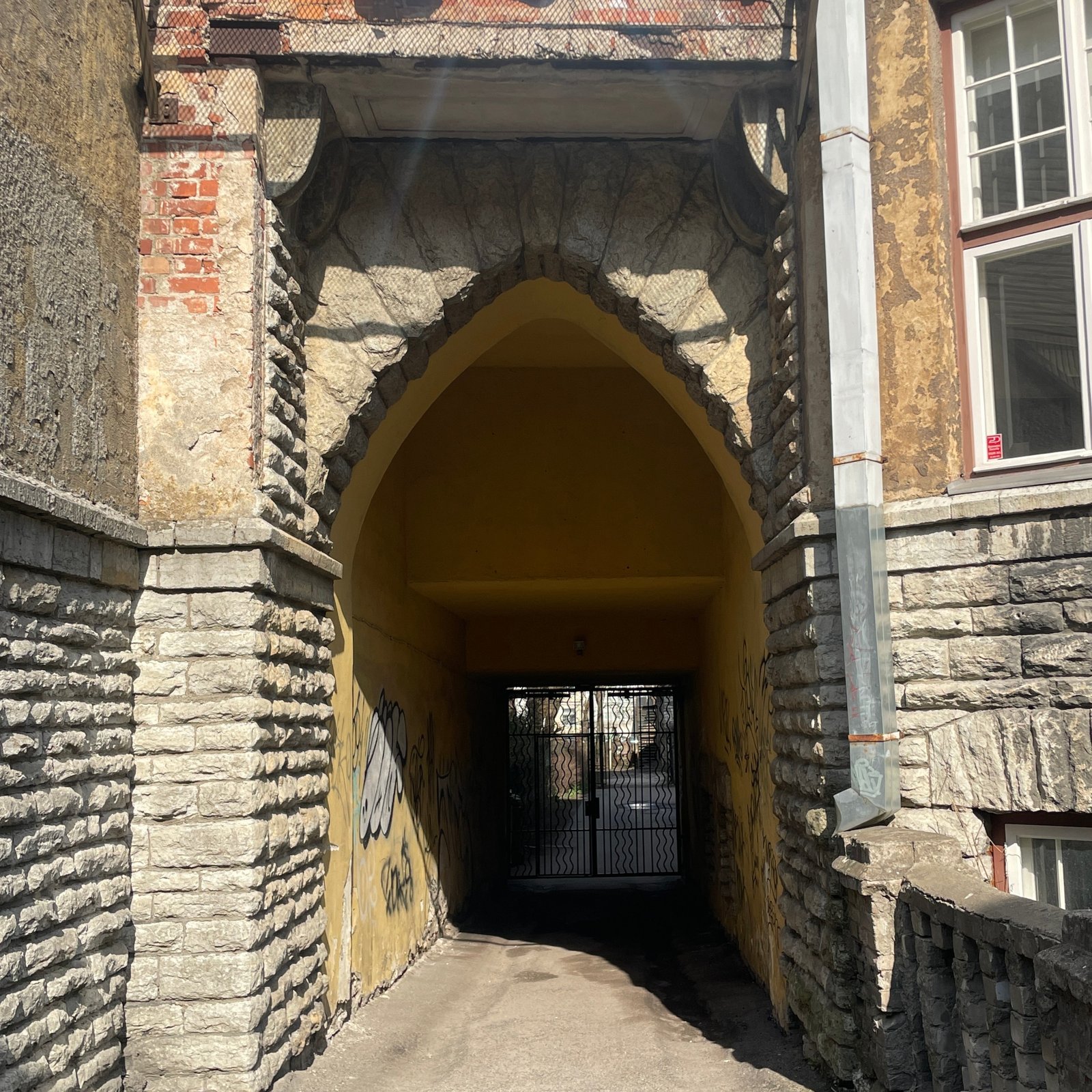
Eye of the needle. Portal at the end of what used to be a narrow street significantly enlarged by the March 9th 1944 bombing (see Harju). The Estonian name seems to be a curtailed translation of the Latin acus episcopi, where acus means needle or, by extension, eye of the needle, likely a calque on Bremen’s oldest gate, Die Natel (MLG de Natlen), aka Bischofsnadel (Bishop’s Needle) or Bischofstor (Bishop’s Gate), built sometime in the early 1200s. Being its first city gate and probably relatively small, earliest records (1274) already suggest it was designed to hinder military forces from entering the city (pretty much the job of any medieval city gate), with subsequent folk etymology accentuating the narrative to make it so small that even a horse and rider, then knight, could not pass through. And small this one is. Past names include Sunte Nyclawes stegel (St Nicholas’ steps, undated, but prob. oldest), Unter den Linden and Подъ Липовая (under the lindens, 1890), Kirchenstegel (church steps, 1913), etc. Nõelasilm was re-built and re-opened 20 August 2007 and, since the name theoretically applies to the archway itself, the alleyway is sometimes referred to as Trepi tänav, erroneously due to it already existing elsewhere, to be confirmed.