
Names
Vana-Mustamäe (Vana-Mustamägi) 
Sometimes known too as Sinisemägi, blue mountain (but see Sinimäe for what it looks like from a distance in the mist). With a quick boing as Trampliini (1965-67), and previously known as plain old Mustamäe and variants Черногорская (Chernogorskaya), which also back-translates as Montenegrin, and Hohenhauptstraße, a 1926 ‘translation’ of MLG hoghe hoved (see Kõrgepea nukk), Sinise mäe (1919) and Синегорская (Sinegorskaya), both meaning blue mountain. See Mäe for discussion.

Vana-Pärnu (Vana-Pärnu)
Old Pärnu. Whether this actually was the ‘old’ road to Parnu remains to be determined. At least, it didn’t seem to be in 1914…
Vana-Posti (Vana-Post)
Old Post, or mail. Known first as quappen strathe or platea / vicus quappenstrate (1367-73), lutso ulits (1732), or Quappenstraße (1737) after the burbots (Lat. Lota lota, Ger. Quappe, Est. luts:lutsu) in the pond in the moat ‘upstream’ of nearby Karjaveski (Karja värav watermill) and, given the distance, perhaps the ditches or water channels running along the road from there. In 1780. Tallinn set up a post office on the corner of Harju, resulting in its next name of Poststraße which, when the PO moved to the corner of Vene and Pühavaimu in 1829, added Alte Poststraße to its name with all-round confusion until the present was setttled upon.
Vana-Rannamõisa (Vana-Rannamõis)
Old Rannamõisa. Ironically, its old name (pre 1977) was without the vana.
Vana-Tartu (Vana-Tartu)
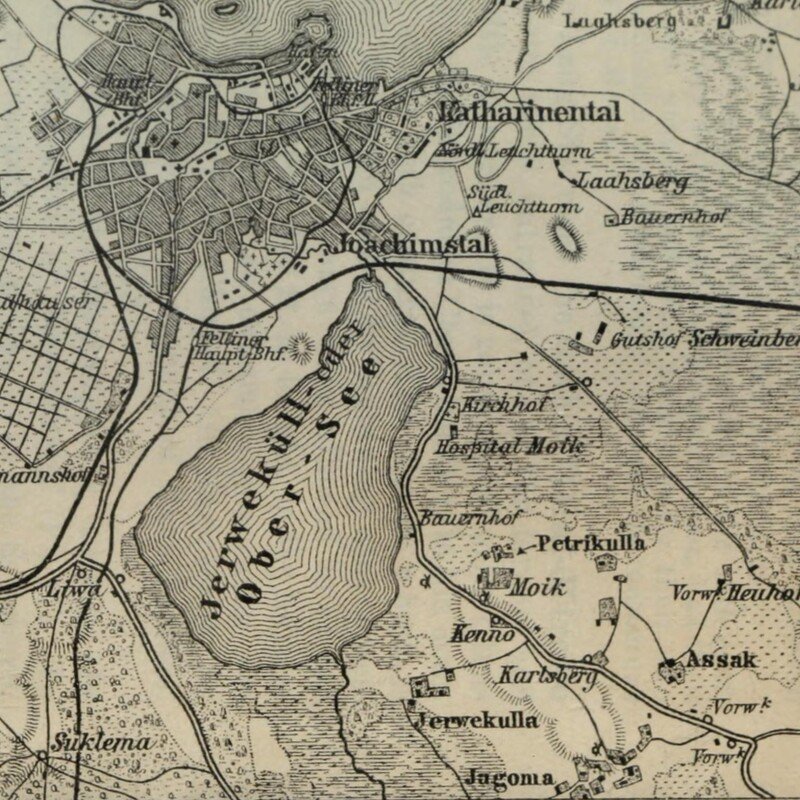
Road ‘splitting off’ today’s main Tartu maantee by the airport, following the shore of lake Ülemiste for a couple of kilometres then swinging back to join the main road again outside Tallinn. This was in fact the ‘old’ Tartu road, as seen on the 1914 Baedeker’s map below. Russian transliteration as Вана-Тарту Шоссе (Vana-Tartu chaussée, the latter from the French).