
Names
Tombi J.
(Jaan Tomp, 1894-1924)
Communist who earned the unhappy distinction of being the only person sentenced to death in the 1924 149 protsess (Trial of the 149, an attempt to smother burgeoning communism). Reincarnated nomino-nautically as an Ecuadorian tanker. Soviet occupation renaming (1940-1991) of Vilmsi J..
Tondi 
(Jobst Dunte, 1, 2, 3, 4 or 5…)
Disappointingly, not from tont, ghost or specter, as local lore would have it, but after the summer estate (see Mõisa) of Jobst Dunte, which all seems nice and simple, but it’s not. Which Jobst (or Jost) Dunte (or Dunt or Dunten)? There are (at least) 5 of the buggers, bred like rabbits, leading to this breakdown:
Jobst Dunte 1, (d. 1579) came to Tartu from Hildesheim, Germany, date unknown, married mayor’s daughter, moved to Tallinn, and had 3 sons (suspects in bold):
- Gert Dunte (d. 1641), various progeny, including grandson:
- Jobst Dunte 4 (c. 1635-1697), Tallinn alderman (raehärra, some say ‘Mayor’) in 1670 and 1688-1696, landowner and trader, after whom Tondi Sub-district is said to be named. May once have lived at Viru tänav 20
- Hans Dunte (1565-1641), moved to Riga so out of the story
- Jobst Dunte 2 (1569-1615), Tallinn alderman, Rector of Niguliste church, member (?) of the ‘Mustpea’, Brotherhood of St. Maurice, or Blackheads (see Jüriöö), probably referred to as Ä., der Ältere (the Elder), although it could also be his father, had 3 sons:
- Jobst Dunte 3 (d. 1624(?) or 1637), merchant, received Keila Mõis outside Tallinn as fief from King Gustaf II Adolf in 1630, sons knighted and ennobled in Sweden. Recruited craftsmen from Germany for church ornamentation. At times confused with this father.
- Ludwig Dunte (1597-1639), clergyman, spoke 9 or 10 languages, churchmen offspring
- Hans Dunte (d. 1640), various descendants including (grandson?):
- Jobst Dunte 5 (1670-1710), Tallinn alderman (some say ‘Mayor’), said to be founder of Dunteni Suvemõis (see Dunteni) in Tondi.
Two candidates for both Tondi asum and Tondi tänav are often seen: 1) Jobst Dunte 4 of c. 1635-1697; and 2) Jobst Dunte 5 of 1670-1710. No clear candidate for Tondiraba. On the night of 1625-06-28/29, a fire in Viru tänav damaged (destroyed?) the house of a Jobst Dunte who, or whose son, later donated bells to Oleviste church in 1671 and 1694. While the donation dates coincide well enough with celebrations for JD4’s mayorship, he’s too late for the fire, unless it refers to his son? To conclude: very little unequivocal data to confirm exactly who is who, and all-round confusion. Did I mention a breakdown? Given the inconsistency in dates, there may even have been a Jobst Dunte 6... Did I mention the Duntenhof Krug dating to at least 1688? See below.
Getting back to ‘ghosts’, although Estonians tend to translate tont (see Vaimu) as above, historically, it was more a house fairy, generally evil, often used as bogeyman for children, while its Swedish ancestor, tomte, was more benign. The more usual term for ghost is kummitus as in Estonia’s favorite tongue-twister: Kummikutes kummitus kummitas kummutis (ask someone to explain). Soviet occupation renaming (1950-1990): Matrossovi A..
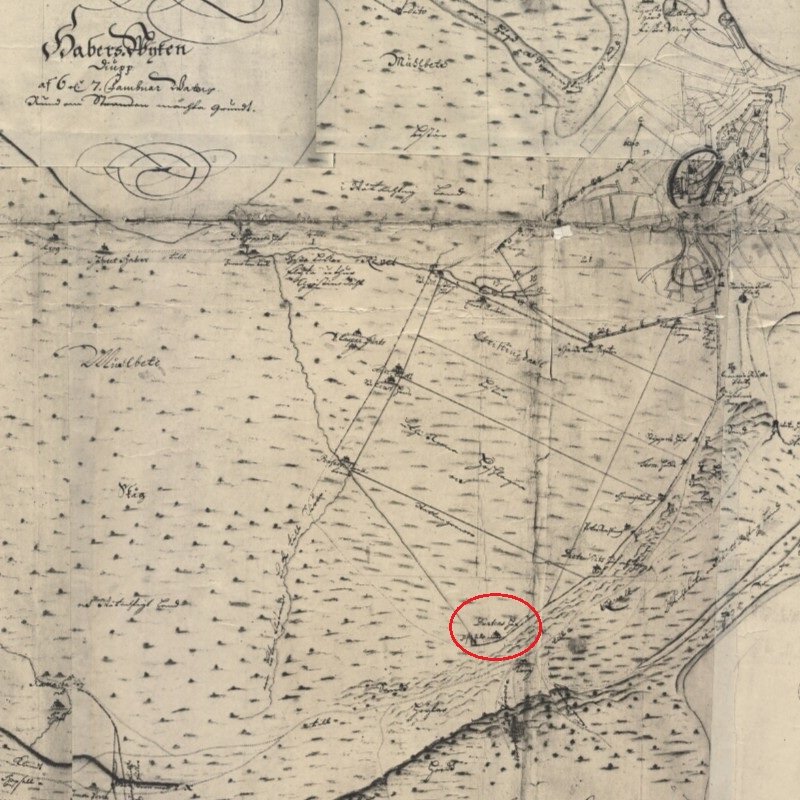
Detail of the 1688 Waxelbergh map of Tallinn showing Duntenhof Inn. ***Link Pending!*** (Click here to view full map)
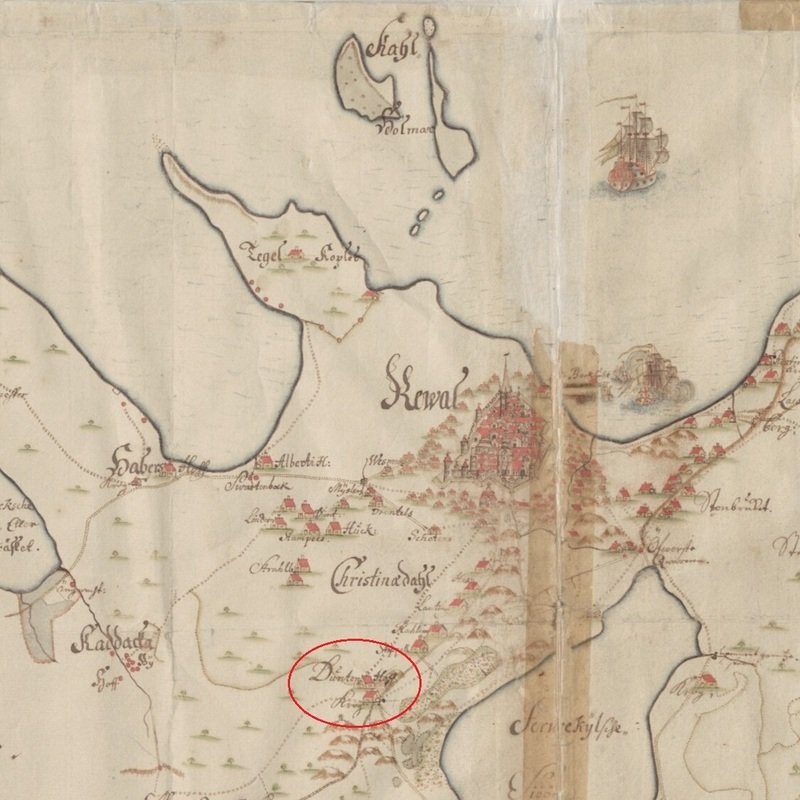
Detail of the 1689 Holmberg map of Tallinn showing Duntenhof Inn. ***Link Pending!*** (Click here to view full map)

Tondiraba (Tondiraba)
‘Ghost’s’ mire/fen/marsh. See Tondi. This part of Tallinn was clearly associated with a member of the Dunte family, since there used to be a Tondi kõrts (inn), aka Tunte Korts or Dunten-Krug (1732) on (now) Narva mnt (///count.youth.planting), roughly equidistant between Katleri Mõis (///clinked.rare.valve), aka Tondi Mõis after the nearby inn, so the manor itself had nothing to do with the Dunte family, although the area had been associated with ‘Tondi’ since the early 1600s, but still unclear as to which one) and Väo Mõis (///types.safari.grass), a linnumõis (see Mõisa) first recorded as Das Gut Faeht (the Faeht property) in 1725, aka Фетъ (Fet), Wäo or Tondi m, all of which spanning a distance of about 2.5 km. While it seems unlikely that Tondi kõrts was related to Katleri Mõis, the westernmost property (which also is said to have run a peat-extraction business, hence the ‑raba ending), Väo Mõis is understood to have been leased to a Jobst Dunte in the 17th C. But which one? As above, see Tondi.
Tõnismäe (Tõnismägi):
St Anthony’s mountain or hill. Confusingly, Tõnismäe, the District, is genitive while the street, uncluttered by any street type (tänav, tee, etc.) is nominative (see Kollane and Tõnismägi below)... Tõnismäe haljak, on the other hand, was known as Vabastajate väljak (Liberators’ square) from 1945-1996. As to the windmill, Tõnismäe tuuleveski aka tuleweski or Wind-Mühle, it seems to have re-imagined itself as a water tower. If water-towers excite your soul, check out Tõnismägi No.12-14. The world will seem less dark. For those with even less taste for life, see Vocabulário Popular de Porto Velho by Beto Bertagna and myself, a slang glossary of Porto Velho, 20th-C Brazilian rubber-boom frontier town upon whose coat of arms figures no less than three water-towers, essential requirement to any town in the Amazon rain forest.